
7 Weeks Pregnant is a busy early pregnancy week because the embryo is growing quickly, symptoms may feel stronger, and many women are waiting for their first prenatal visit.
7 Weeks Pregnant: Symptoms, Baby Development, and What to Expect
At 7 Weeks Pregnant, your baby is still called an embryo, the heart area is developing, tiny limb buds are forming, and early pregnancy symptoms may become harder to ignore.
What Does 7 Weeks Pregnant Mean?
7 Weeks Pregnant means you are seven weeks into the pregnancy timeline, counted from the first day of your last menstrual period. By this point, many women already know they are pregnant because their period is late and a home pregnancy test has turned positive.
At 7 Weeks Pregnant, your baby is still called an embryo. ACOG explains that the developing baby is called an embryo for the first 8 weeks after fertilization, and later it is called a fetus. ACOG
This week can feel emotional because you may be excited, nervous, exhausted, nauseated, or all of those at once. Early pregnancy symptoms may be stronger now because pregnancy hormones are rising quickly.
Many women are also waiting for their first prenatal appointment around this time. Some offices schedule the first visit around 8 to 10 weeks, while others may see you sooner if there is bleeding, pain, fertility treatment, previous loss, or another medical reason.
How Big Is Baby at 7 Weeks Pregnant?
At 7 Weeks Pregnant, the embryo is still very small. Pregnancy guides may use different size comparisons, but the important point is that the embryo is still in an early stage and does not look like a fully formed baby yet.
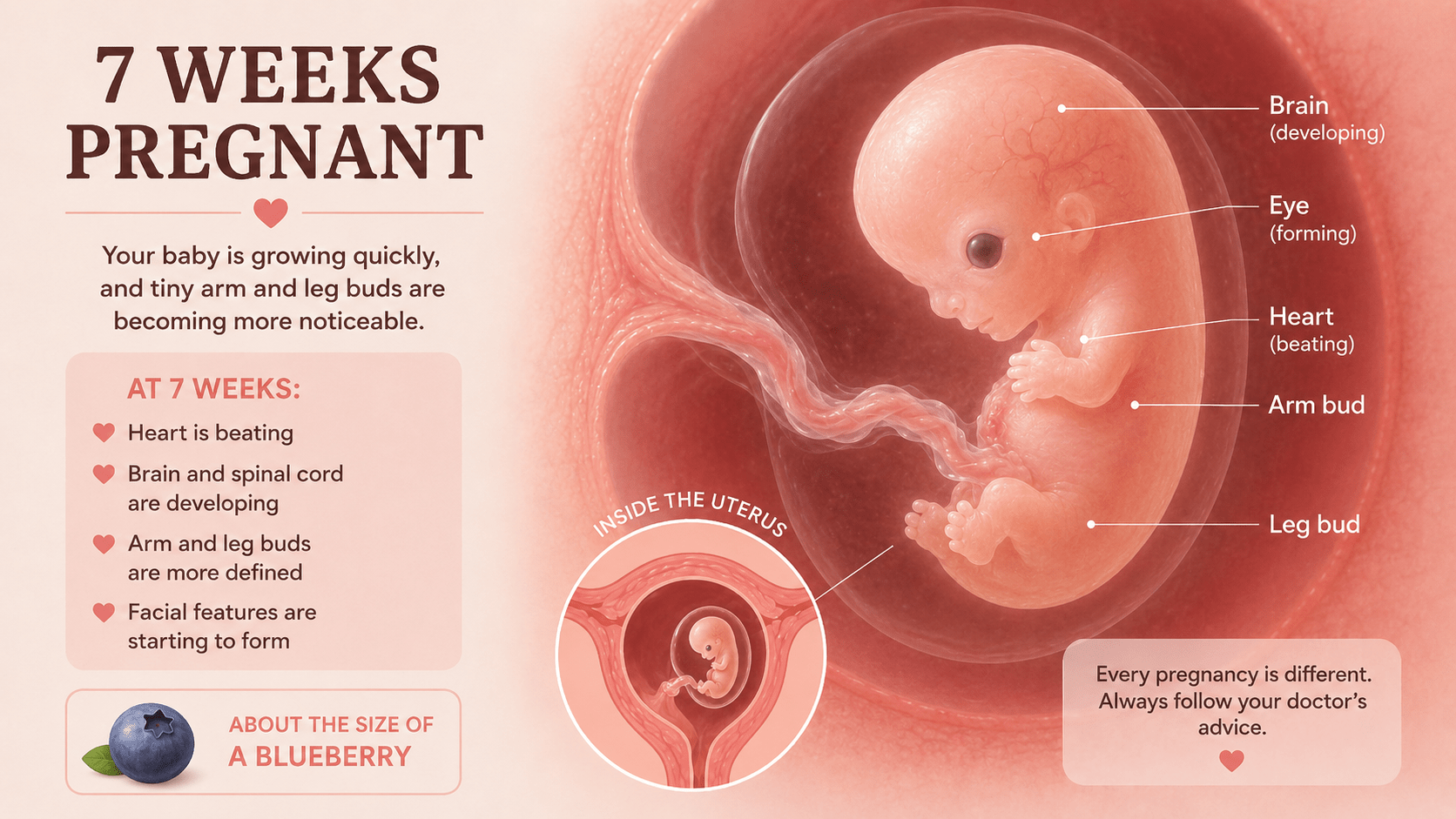
The embryo may have a curved shape, a larger head area compared with the body, and tiny limb buds where arms and legs are developing. Facial areas are also continuing to form, but the features are still very early.
At this stage, a 7 Weeks Pregnant image should look like an early embryo illustration, not a newborn or late-pregnancy fetus. The development is real and important, but it is still very early.
Simple explanation: At 7 Weeks Pregnant, baby is still a tiny embryo. The body is forming quickly, but the embryo does not look like a full baby yet.
7 Weeks Pregnant Baby Development
At 7 Weeks Pregnant, your baby’s early development is moving fast. ACOG notes that during weeks 1 to 8, the embryo stage includes formation of the brain, spine, neural tube, cardiac tissue, parts of the face, inner ear, arm and leg buds, and the early digestive tract. ACOG
Nemours KidsHealth explains that at 7 weeks, the umbilical cord has formed, the digestive tract and lungs continue to form, facial features like the mouth, nostrils, ears, and eyes are becoming more defined, and the arm bud has a hand-like paddle shape. Nemours KidsHealth
The heart area is also developing. Some people may hear or see references to a heartbeat around this time, but the more careful wording is early cardiac activity because the heart is still developing and is not fully formed like a newborn heart.
At 7 Weeks Pregnant, the brain and nervous system are also developing quickly. This is one reason prenatal vitamins with folic acid are often recommended before pregnancy and during early pregnancy.
7 Weeks Pregnant Symptoms
7 Weeks Pregnant symptoms can feel intense for some women. Others still have mild symptoms or symptoms that come and go. Both can happen, and symptom strength does not always tell you how the pregnancy is developing.
The NHS lists symptoms at 7 weeks that may include a metallic taste, sore breasts, headaches, new food and drink likes or dislikes, heightened sense of smell, white milky discharge, light spotting, cramping like period pains, skin changes, and thicker or shinier hair. NHS
You may also feel nausea, fatigue, bloating, constipation, mood swings, frequent urination, or food aversions. Morning sickness can happen at any time of day, not just in the morning.
- Nausea, food aversions, or a stronger sense of smell.
- Fatigue that feels heavier than normal tiredness.
- Sore, tender, swollen, or sensitive breasts.
- Mild cramping or stretching feelings.
- Light spotting for some women.
- Metallic taste in the mouth.
- Headaches, mood swings, or feeling emotional.
- Frequent urination or needing to pee more often.
Is Cramping Normal at 7 Weeks Pregnant?
Mild cramping at 7 Weeks Pregnant can happen. Some women feel pulling, stretching, or period-like cramps as the uterus begins changing and hormones continue rising.
Cramping can be scary, especially when the pregnancy is still early. Mild cramps without heavy bleeding are common for many women, but severe pain should always be checked.
Call your doctor right away if cramping is severe, one-sided, comes with heavy bleeding, shoulder pain, dizziness, fainting, fever, or pain that feels very different from your usual cramps.
Is Spotting Normal at 7 Weeks Pregnant?
Some women have light spotting at 7 Weeks Pregnant. Light spotting does not always mean something is wrong, but it should still be mentioned to your healthcare provider, especially if it is new or worrying.
Bleeding that becomes heavy, bright red, painful, or comes with dizziness, shoulder pain, or one-sided pelvic pain should be checked quickly. Your doctor may decide whether you need bloodwork, an ultrasound, or monitoring.
Because early pregnancy can be stressful, it is okay to call and ask rather than sitting with fear. Your provider would rather know about bleeding and help you decide what to do next.
Can You See Anything on Ultrasound at 7 Weeks Pregnant?
At 7 Weeks Pregnant, an ultrasound may show more than it did at 5 or 6 weeks, but timing still matters. If ovulation happened later than expected, the pregnancy may measure earlier than the calendar suggests.
Depending on timing and the type of scan, a provider may be able to see a gestational sac, yolk sac, embryo, and cardiac activity. However, exact findings can vary from pregnancy to pregnancy.
If your scan does not match your expected dates, your provider may repeat the ultrasound later. A few days can make a major difference in very early pregnancy.
Can You Hear a Heartbeat at 7 Weeks Pregnant?
At 7 Weeks Pregnant, cardiac activity may be visible on ultrasound for many pregnancies, but not every pregnancy is dated exactly. Some women ovulate later, implant later, or have uncertain cycle dates.
If cardiac activity is not seen when expected, your provider may look at measurements, dates, hCG levels, symptoms, and whether a repeat scan is needed. Try not to panic before your doctor explains what the findings mean.
The heart is still developing at this stage, so it is more accurate to think of this as early cardiac activity rather than a fully developed baby heartbeat.
What Your Body May Be Doing at 7 Weeks Pregnant
At 7 Weeks Pregnant, your hormones are still rising and your body is adjusting to pregnancy. This can affect your breasts, digestion, energy, mood, bladder, appetite, and sense of smell.
You may feel bloated even though you do not look obviously pregnant yet. Bloating is usually from hormones slowing digestion, not from a large uterus at this stage.
Fatigue can also be intense. Your body is supporting early pregnancy development, and simple things like work, errands, cooking, or normal chores may feel harder than usual.
What to Do at 7 Weeks Pregnant
If you are 7 Weeks Pregnant, make sure you have contacted your doctor or midwife. They can tell you when to schedule your first prenatal appointment and what to do before then.
Keep taking a prenatal vitamin with folic acid if your provider recommends it. Ask before starting, stopping, or changing any medications, supplements, or herbal products.
This is also a good week to focus on practical basics. Try to eat what you can tolerate, drink fluids, rest when possible, and avoid alcohol, smoking, and unsafe substances.
- Schedule or confirm your first prenatal appointment.
- Keep taking a prenatal vitamin with folic acid if recommended.
- Ask your doctor about medication and supplement safety.
- Eat small meals or snacks if nausea is strong.
- Drink fluids throughout the day, even in small sips.
- Avoid alcohol, smoking, and unsafe substances.
- Call your provider for bleeding, severe pain, or symptoms that worry you.
What to Eat at 7 Weeks Pregnant
At 7 Weeks Pregnant, food may feel difficult. Nausea, smell sensitivity, and food aversions can make normal meals feel impossible. The goal is not perfection. The goal is getting through the day safely and keeping fluids down.
Small, frequent snacks may help more than large meals. Bland foods like crackers, toast, rice, potatoes, applesauce, bananas, soup, noodles, cereal, yogurt, or simple proteins may be easier to tolerate.
If nausea is worse when your stomach is empty, try keeping crackers near your bed and eating a small bite before getting up. Call your doctor if you cannot keep fluids down, are losing weight, or feel dehydrated.
What Not to Worry About Too Much at 7 Weeks Pregnant
It is easy to worry at 7 Weeks Pregnant, especially if symptoms change from one day to the next. Symptoms can come and go in early pregnancy, and that does not automatically mean something is wrong.
It is also normal to feel anxious before the first appointment or ultrasound. The waiting can feel long, especially when you want reassurance.
Try not to compare your symptoms, ultrasound timing, or pregnancy experience to someone else’s. One person may be very sick at 7 weeks, while another may feel mostly normal.
When to Call Your Doctor
Most mild symptoms at 7 Weeks Pregnant can be normal, but some symptoms should be checked quickly. Trust your instincts if something feels severe, unusual, or unsafe.
Call your doctor right away for heavy bleeding, severe cramping, one-sided pelvic pain, shoulder pain, dizziness, fainting, fever, or vomiting that keeps you from holding down fluids. This page is for general education and does not replace medical care.
7 Weeks Pregnant Summary
7 Weeks Pregnant is an active early pregnancy week. Your baby is still an embryo, but the umbilical cord, facial areas, early limb buds, digestive tract, lungs, brain, spine, and cardiac tissue are developing.
The most important things to know about 7 Weeks Pregnant are simple: symptoms may be stronger, mild cramping can happen, ultrasound findings depend on exact dating, and the embryo still does not look like a fully formed baby.
If you are 7 Weeks Pregnant, keep taking care of your body, stay in contact with your healthcare provider, and call right away for heavy bleeding, severe pain, or symptoms that worry you.