
6 Weeks Pregnant is often when early pregnancy symptoms become stronger, and the embryo is growing quickly even though it is still very tiny.
6 Weeks Pregnant: Symptoms, Baby Development, and What to Expect
At 6 Weeks Pregnant, your baby is still called an embryo, important organs are forming, pregnancy hormones are rising, and you may start feeling more noticeable early pregnancy symptoms.
What Does 6 Weeks Pregnant Mean?
6 Weeks Pregnant means you are six weeks into the pregnancy timeline, counted from the first day of your last menstrual period. By this point, many women have already missed a period, taken a positive pregnancy test, and started thinking about their first prenatal appointment.
At 6 Weeks Pregnant, your baby is still called an embryo. ACOG explains that the developing baby is called an embryo for the first 8 weeks after fertilization, and then it is called a fetus later in pregnancy. ACOG
This is still very early, but it is also an active week for development. The brain, spine, heart tissue, facial areas, and early limb buds are forming. Your body may also be producing enough pregnancy hormones to make symptoms feel stronger than they did in week 4 or week 5.
Many women feel emotional at 6 Weeks Pregnant because the pregnancy may finally feel real, but it can also feel uncertain. Symptoms may come and go, ultrasound findings can vary by dating, and your first appointment may still be a few weeks away.
How Big Is Baby at 6 Weeks Pregnant?
At 6 Weeks Pregnant, the embryo is still very small. Different pregnancy guides use slightly different size comparisons for this week, but the main point is the same: the embryo is tiny and still in an early developmental stage.
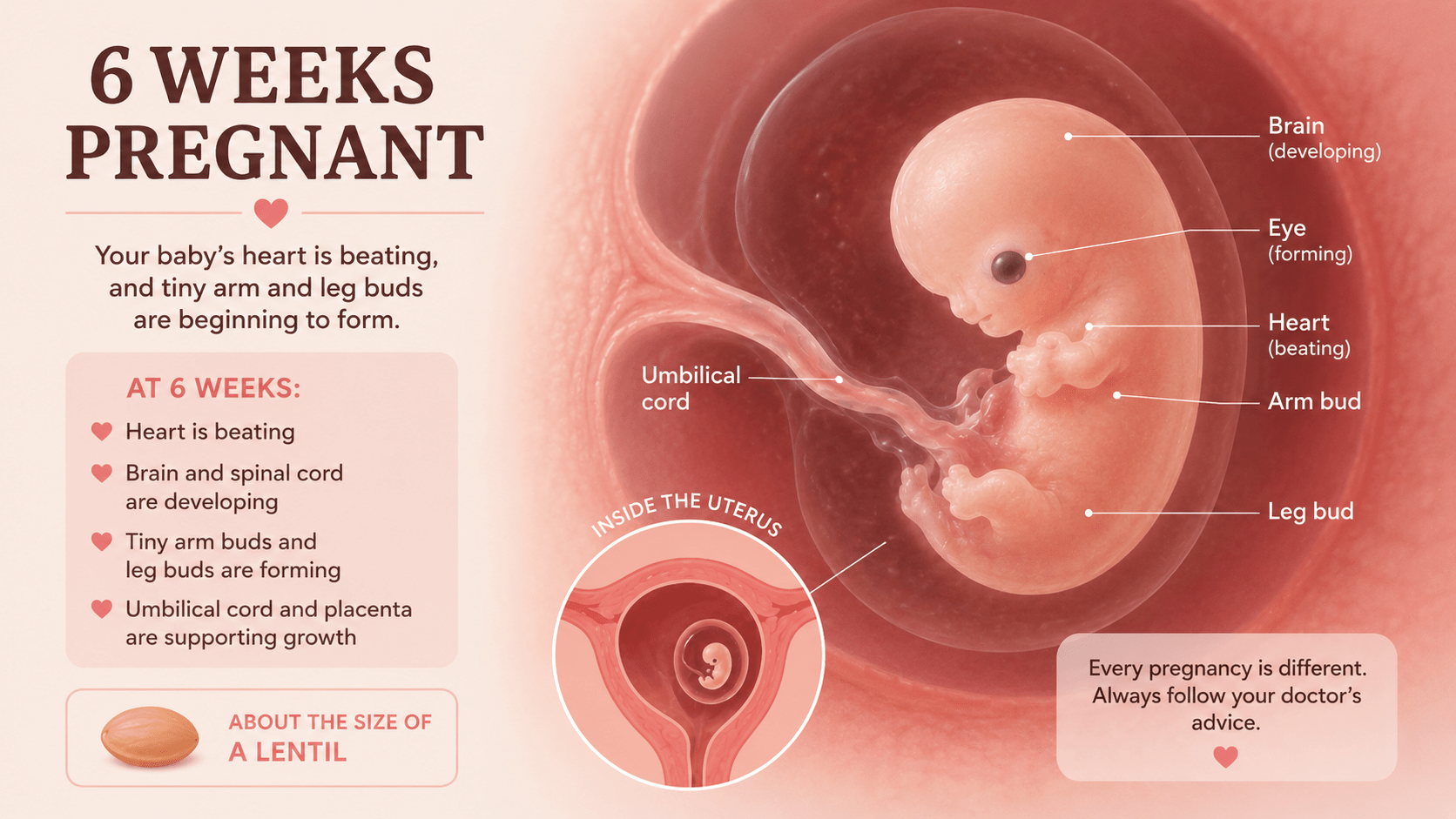
The embryo may be described as looking curved, with a shape that is not baby-like yet. It may have early limb buds, a large head area compared with the rest of the body, and developing structures where the face, ears, and eyes will continue forming.
Because the embryo is so small at 6 Weeks Pregnant, it should not be shown as a fully formed baby. A more accurate image is a tiny embryo-style illustration, not a newborn or a late-pregnancy fetus.
Simple explanation: At 6 Weeks Pregnant, your baby is still a tiny embryo. Important development is happening fast, but the embryo does not look like a full baby yet.
6 Weeks Pregnant Baby Development
At 6 Weeks Pregnant, major early development continues. ACOG notes that during weeks 1 to 8, the embryo stage includes early formation of the brain, spine, neural tube, cardiac tissue, parts of the face, and inner ear. ACOG
The heart area is developing, and cardiac activity may sometimes be seen around this stage on ultrasound. However, timing matters a lot. If ovulation happened later than expected, it may still be too early to see clear cardiac activity.
At 6 Weeks Pregnant, tiny limb buds may also be starting to form. These are early beginnings of arms and legs, but they do not look like full arms and legs yet. The embryo’s shape is still curved and very small.
The placenta and umbilical cord structures are also continuing to develop. These will eventually help support the baby with oxygen and nutrients, but they are still early in the process during week 6.
6 Weeks Pregnant Symptoms
6 Weeks Pregnant symptoms can feel stronger because pregnancy hormones are rising. Some women feel very pregnant now, while others still feel only mild changes. Both can happen.
The NHS lists several early pregnancy symptoms around 6 weeks, including sore breasts, mood swings, headaches, new food likes and dislikes, heightened smell, peeing more often, milky white discharge, light spotting, and cramping that can feel a bit like period pains. NHS
You may also notice fatigue, nausea, food aversions, bloating, or feeling emotional. Some women feel hungry all the time, while others can barely tolerate certain foods or smells.
- Nausea, food aversions, or stronger smell sensitivity.
- Sore, swollen, or tender breasts.
- Fatigue that feels stronger than normal tiredness.
- Mood swings, crying easily, or feeling anxious.
- Mild cramping or pulling sensations.
- Frequent urination or feeling like you need to pee more often.
- Milky white discharge, which can be common in early pregnancy.
- Light spotting for some women, though bleeding should be discussed with a doctor.
Is Cramping Normal at 6 Weeks Pregnant?
Mild cramping at 6 Weeks Pregnant can happen. The uterus is beginning to change, hormones are shifting, and some women feel pulling, stretching, or period-like sensations.
Cramping can still feel scary, especially if you have already had a positive test. Mild cramps without heavy bleeding can be common, but severe pain should always be checked.
Call your doctor right away if cramping is severe, one-sided, comes with heavy bleeding, shoulder pain, dizziness, fainting, fever, or pain that feels very different from your normal cramps.
Is Spotting Normal at 6 Weeks Pregnant?
Some women have light spotting at 6 Weeks Pregnant, and it does not always mean something is wrong. Light spotting can happen in early pregnancy for different reasons.
However, bleeding during pregnancy should be mentioned to your doctor or midwife, especially if it becomes heavy, bright red, painful, or comes with dizziness or one-sided pain.
If you are unsure whether spotting is normal, it is always better to call and ask. Your provider can decide whether you need bloodwork, an exam, an ultrasound, or simple monitoring.
Can You See Anything on Ultrasound at 6 Weeks Pregnant?
At 6 Weeks Pregnant, an ultrasound may show early pregnancy structures, but what is visible can vary. Some women may see a gestational sac, yolk sac, tiny embryo, or flicker of cardiac activity. Others may be too early to see all of that clearly.
A 6-week ultrasound can be affected by ovulation timing, implantation timing, cycle length, and whether the scan is abdominal or transvaginal. Even being off by a few days can change what is visible.
If your doctor does not order an ultrasound at 6 Weeks Pregnant, that can be normal. Many providers schedule the first ultrasound later because it is easier to confirm dating and development when the pregnancy is farther along.
Can You Hear a Heartbeat at 6 Weeks Pregnant?
At 6 Weeks Pregnant, cardiac activity may sometimes be seen on ultrasound, but it may be too early for some pregnancies. The wording matters because this is early embryonic cardiac activity, not a fully developed heart like a newborn has.
If cardiac activity is not seen at exactly 6 weeks, your provider may repeat an ultrasound later, especially if your dates could be off. A few days can make a big difference this early.
Try not to panic if the first scan is unclear. Your doctor will interpret the scan based on measurements, dates, symptoms, and sometimes repeat testing.
What Your Body May Be Doing at 6 Weeks Pregnant
At 6 Weeks Pregnant, your body is adjusting to rising hCG and progesterone. These hormones help support the pregnancy, but they can also cause symptoms like nausea, bloating, tiredness, breast tenderness, and mood changes.
Your uterus is still small, but blood flow is increasing and early pregnancy changes are underway. You may not look pregnant yet, but you may feel very different inside your body.
Fatigue can be especially strong at 6 Weeks Pregnant. Your body is working hard, and even normal daily tasks may feel more draining than usual.
What to Do at 6 Weeks Pregnant
If you are 6 Weeks Pregnant, call your doctor or midwife if you have not already. They can tell you when to schedule your first prenatal appointment and what to do before then.
Keep taking a prenatal vitamin with folic acid if recommended. Ask your provider before starting, stopping, or changing medications, supplements, or herbal products.
This is also a good time to focus on simple habits. Drink water, eat what you can tolerate, rest when possible, and avoid alcohol, smoking, and unsafe substances.
- Schedule your first prenatal appointment if you have not already.
- Keep taking a prenatal vitamin with folic acid if recommended.
- Ask your provider about medication and supplement safety.
- Eat small meals or snacks if nausea is making meals difficult.
- Drink fluids throughout the day, even if you need small sips.
- Avoid alcohol, smoking, and unsafe substances.
- Call your doctor for heavy bleeding, severe pain, or concerning symptoms.
What to Eat at 6 Weeks Pregnant
At 6 Weeks Pregnant, nausea and food aversions can make eating harder. Some women do better with small, frequent snacks instead of large meals.
Bland foods may be easier to tolerate, such as crackers, toast, rice, potatoes, applesauce, bananas, soup, or plain pasta. Protein can also help some women feel steadier, but strong smells may make certain foods difficult.
If nausea is strong, try eating a small snack before getting out of bed, avoiding empty stomach periods, and drinking fluids in small sips. Call your doctor if you cannot keep fluids down.
What Not to Worry About Too Much at 6 Weeks Pregnant
It is easy to worry at 6 Weeks Pregnant. You may wonder if symptoms are too strong, too weak, or changing too much. Early pregnancy symptoms can come and go, and that does not automatically mean something is wrong.
It is also common to worry about ultrasound timing. At 6 weeks, seeing or not seeing certain things can depend heavily on exact dating. Your provider may repeat a scan if anything is unclear.
Try not to compare your pregnancy to someone else’s. One person may have intense nausea at 6 Weeks Pregnant, while another may feel mostly normal. Every pregnancy can feel different.
When to Call Your Doctor
Most mild symptoms at 6 Weeks Pregnant can be normal, but some symptoms should be checked quickly. Trust your instincts if something feels severe, unusual, or unsafe.
Call your doctor right away for heavy bleeding, severe cramping, one-sided pelvic pain, shoulder pain, dizziness, fainting, fever, or vomiting that keeps you from holding down fluids. This page is for general education and does not replace medical care.
6 Weeks Pregnant Summary
6 Weeks Pregnant is an early but active week. The embryo is still tiny, but major development is happening quickly, and early symptoms may become more noticeable.
The most important things to know about 6 Weeks Pregnant are simple: the embryo does not look like a fully formed baby yet, symptoms can vary, and ultrasound findings can depend on exact dating.
If you are 6 Weeks Pregnant, keep taking care of your body, contact your provider for prenatal appointment guidance, and call right away for severe pain, heavy bleeding, or symptoms that worry you.