
4 Weeks Pregnant is often around the time a missed period may happen, and some women may finally start wondering if they could be pregnant.
4 Weeks Pregnant: Implantation, Symptoms, and What to Expect
At 4 Weeks Pregnant, implantation may have happened, pregnancy hormone may be rising, and a home pregnancy test may start showing a positive result for some women.
What Does 4 Weeks Pregnant Mean?
4 Weeks Pregnant usually means you are four weeks into the pregnancy timeline, counting from the first day of your last menstrual period. This is often around the time a period is expected, which is why many women first start to suspect pregnancy during this week.
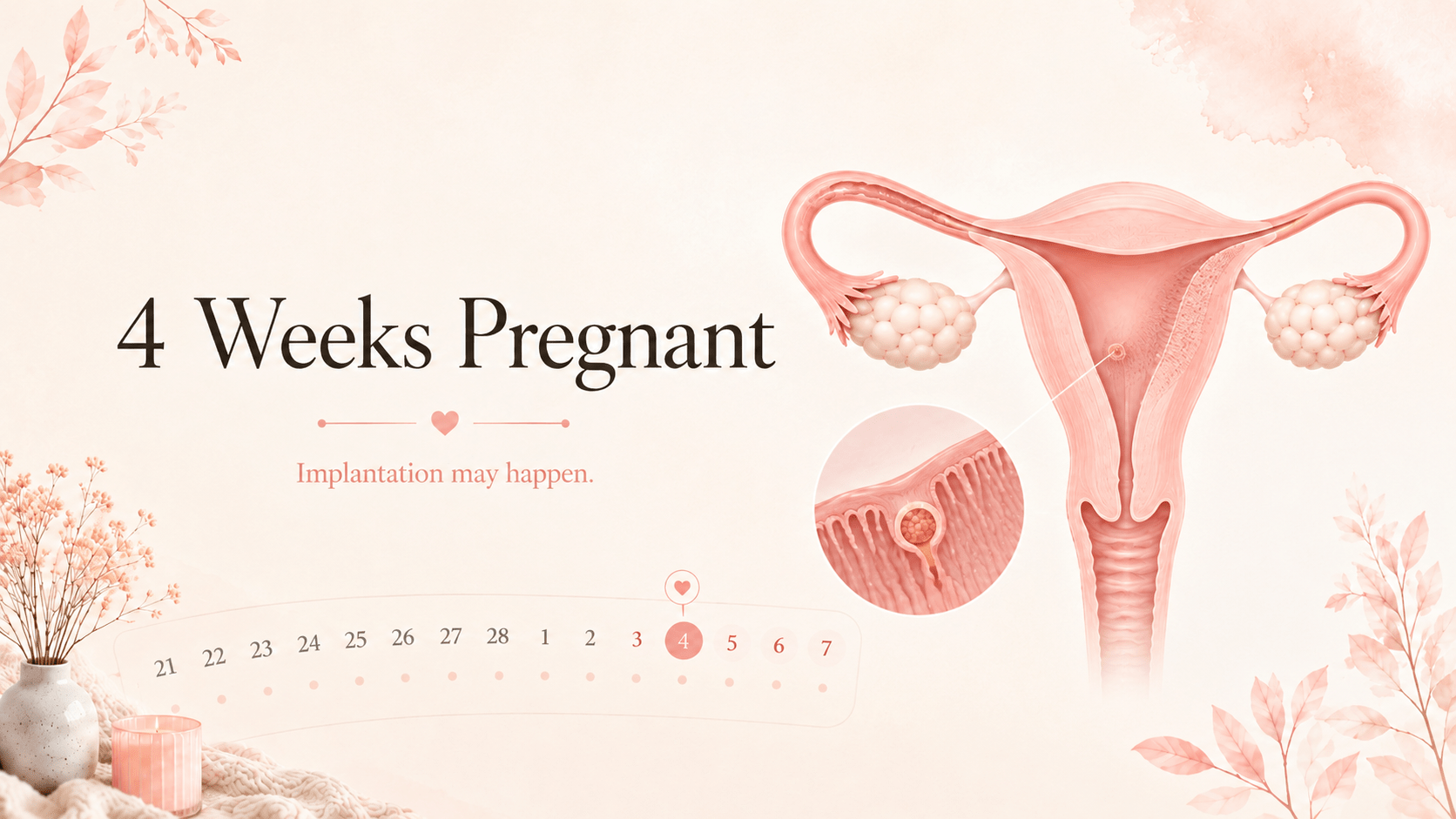
At 4 Weeks Pregnant, fertilization may have already happened, and implantation may have happened or may be finishing. Implantation is when the early pregnancy attaches to the lining of the uterus. After implantation, the body begins producing more pregnancy hormone, called hCG.
This is still extremely early. A baby-shaped embryo is not visible yet, and most of the development is happening at a tiny cellular level. But even though everything is small, this week can feel emotionally huge because a pregnancy test may finally become positive.
Because pregnancy is dated from the first day of the last menstrual period, 4 Weeks Pregnant can sound like you have been pregnant for a full month. In reality, conception often happened about two weeks earlier, depending on when ovulation occurred.
Is There a Baby at 4 Weeks Pregnant?
At 4 Weeks Pregnant, there is not a baby-looking fetus yet. The pregnancy is still very tiny. The early group of cells is developing quickly, and the structures that will later become the embryo and placenta are beginning to form.
This is why a 4 Weeks Pregnant image should not look like a fully formed baby. At this stage, the pregnancy is microscopic or very close to microscopic. The body is working on implantation, early cell growth, and hormone signals.
Many women are surprised by how early the pregnancy calendar starts. The first weeks are more about dating, ovulation, fertilization, implantation, and early hormone changes than visible baby development.
Simple explanation: 4 Weeks Pregnant is often around the missed period week. The pregnancy may be implanted, hCG may be rising, and a test may start turning positive, but the baby is still at a very early stage.
4 Weeks Pregnant Baby Development
At 4 Weeks Pregnant, early development is happening fast. The fertilized egg has divided into many cells, and the early pregnancy may now be attached to the uterine lining. Some cells will develop into the embryo, while others help form the placenta.
The placenta will eventually help provide oxygen and nutrients to the growing baby, but at 4 Weeks Pregnant, it is still in the earliest stages. The amniotic sac and yolk sac may also begin forming around this time.
The yolk sac is especially important in very early pregnancy because it helps support the embryo before the placenta fully takes over. This all happens before there is much to see on an ultrasound.
At 4 Weeks Pregnant, the embryo is still tiny, and a heartbeat is not usually seen yet. That comes later for most pregnancies. This week is more about the beginning foundation of pregnancy than visible baby features.
4 Weeks Pregnant Symptoms
4 Weeks Pregnant symptoms can be very mild, and some women do not feel pregnant at all. Others may notice symptoms that feel a lot like period symptoms. This can make the week confusing because early pregnancy and premenstrual symptoms can overlap.
You may feel cramping, bloating, breast tenderness, fatigue, mood changes, mild nausea, increased urination, or a stronger sense of smell. Some women also notice light spotting around implantation, though many do not have any spotting at all.
At 4 Weeks Pregnant, symptoms can come and go. One day you may feel tired and crampy, and the next day you may feel normal. That does not automatically mean anything is wrong. Hormones are still rising, and every body responds differently.
- A missed period or period that does not arrive when expected.
- Mild cramping that can feel similar to period cramps.
- Breast tenderness, swelling, or sensitivity.
- Fatigue, mood changes, or feeling emotional.
- Bloating, mild nausea, or food sensitivity.
- Light spotting for some women around implantation.
- No symptoms at all for some women, which can also be normal.
Can You Take a Pregnancy Test at 4 Weeks Pregnant?
At 4 Weeks Pregnant, many women can take a home pregnancy test, especially if their period is late. Pregnancy tests look for hCG, the hormone that rises after implantation.
Some tests may detect hCG before a missed period, but testing too early can still lead to a negative result. If you test at 4 Weeks Pregnant and the test is negative, but your period still does not come, it may help to test again in a day or two.
Using first-morning urine can sometimes make a test easier to read because hCG may be more concentrated. Always follow the test instructions, and call your healthcare provider if you have confusing results or symptoms that worry you.
What Implantation May Feel Like at 4 Weeks Pregnant
Implantation happens when the early pregnancy attaches to the uterine lining. By 4 Weeks Pregnant, implantation may already have happened, or it may be finishing depending on ovulation timing.
Some women notice light spotting or mild cramps around implantation. The spotting is usually lighter than a period and may be pink, brown, or very light red. Many women have no implantation bleeding at all.
Cramping at 4 Weeks Pregnant can feel scary, especially after a positive test, but mild cramps can happen as the uterus and hormones begin changing. Severe pain, heavy bleeding, or one-sided pain should always be checked by a doctor.
What Your Body May Be Doing at 4 Weeks Pregnant
At 4 Weeks Pregnant, your body may be producing more hCG. This hormone tells your body to support the pregnancy and helps keep progesterone levels up. Progesterone helps maintain the uterine lining.
Your body may also be increasing blood flow to the uterus. Hormone changes can affect your breasts, digestion, emotions, and energy level. This is why symptoms can feel different from day to day.
Even if you do not feel much yet, your body is still doing important work. Some women have strong symptoms early, while others feel almost nothing at 4 Weeks Pregnant.
What to Do at 4 Weeks Pregnant
If you think you are 4 Weeks Pregnant, this is a good time to take a pregnancy test if your period is late. If the test is positive, you can call your doctor or midwife to ask what they recommend next.
Many offices do not schedule the first prenatal visit immediately unless there are concerns, but they can tell you when to come in and what to do in the meantime. They may ask for the first day of your last menstrual period to estimate your due date.
Keep taking a prenatal vitamin if your healthcare provider recommends one. Try to avoid alcohol, smoking, and unsafe substances. If you take medications, ask your doctor which ones are safe to continue during pregnancy.
- Take a pregnancy test if your period is late.
- Call your doctor or midwife after a positive test.
- Write down the first day of your last menstrual period.
- Keep taking a prenatal vitamin if recommended.
- Ask about medication safety if you take prescriptions or supplements.
- Avoid smoking, alcohol, and unsafe substances.
- Rest when you can and drink enough water.
What Not to Worry About Too Much at 4 Weeks Pregnant
It is normal to feel nervous at 4 Weeks Pregnant. This is often the week when women are waiting, testing, retesting, and wondering whether everything is okay.
Try not to panic if your symptoms are mild. Some women have no nausea, no strong breast pain, and no obvious symptoms this early. That does not automatically mean there is a problem.
It is also normal if your test line is faint at first. A faint positive can happen when hCG is still low. In many pregnancies, the line gets darker over the next few days, but test darkness is not a perfect way to measure pregnancy health.
Can You See Anything on Ultrasound at 4 Weeks Pregnant?
At 4 Weeks Pregnant, it may be too early to see much on ultrasound. Sometimes a tiny gestational sac may be seen later in this stage, but often doctors wait until later because very early ultrasounds can be unclear.
Not seeing much at 4 Weeks Pregnant does not automatically mean something is wrong. Timing matters a lot. Ovulation may have happened later than expected, which can make a pregnancy look earlier than the calendar suggests.
Your doctor will decide if and when an ultrasound is needed. If there is pain, bleeding, previous ectopic pregnancy, or other concerns, they may check sooner.
When to Call Your Doctor
Most mild cramps, bloating, and breast tenderness at 4 Weeks Pregnant can be normal. But some symptoms should be checked quickly, especially if they are severe or unusual for you.
Call your healthcare provider if you have heavy bleeding, severe pain, one-sided pelvic pain, shoulder pain, dizziness, fainting, fever, or symptoms that make you feel unsafe. It is always better to ask than to sit with fear.
Call your doctor right away for heavy bleeding, severe pelvic pain, one-sided pain, fainting, shoulder pain, fever, or pain that feels very different from your normal cramps. This page is for general education and does not replace medical care.
4 Weeks Pregnant Summary
4 Weeks Pregnant is often the missed period week. Implantation may have happened, hCG may be rising, and a home pregnancy test may start showing a positive result.
The most important things to know about 4 Weeks Pregnant are simple: the pregnancy is still extremely early, symptoms can be mild or absent, and the baby is not shaped like a baby yet.
If you get a positive test at 4 Weeks Pregnant, take a breath and call your doctor or midwife for next steps. Keep taking care of your body, avoid unsafe substances, and remember that every pregnancy timeline can vary a little.