
39 Weeks Pregnant is part of the third trimester and is considered full term in many medical systems. At 39 weeks pregnant, baby is very close to birth, movement should still follow your baby’s normal pattern, and labor could begin soon or still be a little while away.
39 Weeks Pregnant: Symptoms, Baby Development, and What to Expect
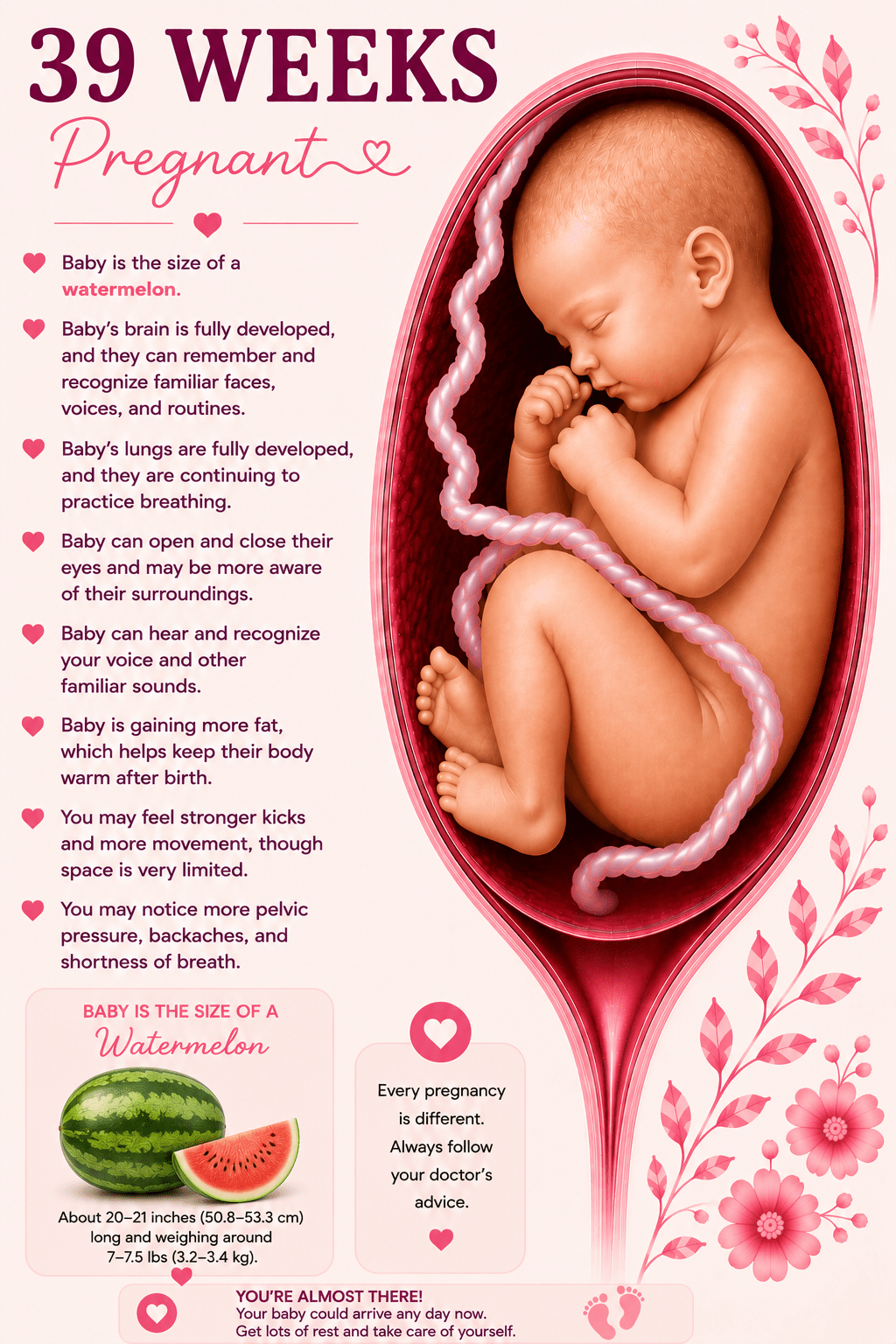
At 39 Weeks Pregnant, your baby is about the size of a watermelon, baby is adding more body fat for warmth after birth, the skin is more protective, and full-term symptoms like Braxton Hicks, pelvic pressure, vaginal discharge, backache, swelling, leaking nipples, and labor signs may become more noticeable.
What Does 39 Weeks Pregnant Mean?
39 Weeks Pregnant means you are thirty-nine weeks into the pregnancy timeline, counted from the first day of your last menstrual period. You are in the third trimester, and in many United States medical guidelines, 39 weeks is considered full term.
At 39 Weeks Pregnant, your baby is very close to birth, but labor does not always start right at 39 weeks. Some babies arrive this week, while others wait until 40 weeks or later. Your provider will keep watching your blood pressure, symptoms, baby’s movement, baby’s position, and any signs that labor may be starting.
The NHS says that at 39 weeks, baby is around 50.7 cm long from head to heel, about the size of a watermelon. The NHS also says baby is growing a tougher new layer of skin that looks more solid and helps protect the internal organs and support temperature control. NHS
At 39 Weeks Pregnant, your provider may also discuss baby movement, blood pressure checks, urine checks, bump measurement, baby position, signs of labor, contractions, waters breaking, membrane sweep options, induction timing if pregnancy continues, birth preferences, and when to call the hospital.
39 Weeks Pregnant Baby Size
At 39 Weeks Pregnant, baby is about the size of a watermelon according to the NHS. The NHS gives a measurement of around 50.7 cm from head to heel. NHS
Size comparisons can vary by pregnancy guide, but a watermelon is the week-specific comparison from the NHS. The main point is that baby is close to birth, gaining strength, and continuing final growth.
At 39 Weeks Pregnant, baby size can vary a lot. Some healthy babies are smaller, and some are larger. Your provider will use your measurements, medical history, and any needed scans or monitoring to decide whether baby’s growth is on track.
Simple explanation: At 39 Weeks Pregnant, baby is about the size of a watermelon according to the NHS and measures around 50.7 cm from head to heel.
39 Weeks Pregnant Baby Development
At 39 Weeks Pregnant, baby development is focused on final preparation for birth, body fat, temperature control, feeding readiness, movement, and continued brain and immune system support.
Mayo Clinic says that at week 39, baby is considered full term, the chest is getting larger, and fat is being added all over the body to help keep baby warm after birth. Mayo Clinic
Cleveland Clinic says full term means 39 weeks and 0 days through 40 weeks and 6 days. Cleveland Clinic also says that at week 39, the fetus is full term and ready to meet the world. Cleveland Clinic Cleveland Clinic
At 39 Weeks Pregnant, baby may sleep, wake, roll, stretch, suck, grasp, respond to sounds, detect light, swallow amniotic fluid, practice breathing movements, and have active and quiet times. Baby should still move right up to and during labor.
39 Weeks Pregnant Symptoms
39 Weeks Pregnant symptoms may feel stronger because your body is very close to birth. Your back, hips, pelvis, bladder, legs, lower belly, and ribs may all feel more pressure, especially if baby is lower in the pelvis.
The NHS lists common symptoms at 39 weeks, including Braxton Hicks contractions, sleeping problems, stretch marks, swollen and bleeding gums, round ligament pains, piles, headaches, backache, indigestion and heartburn, bloating and constipation, leg cramps, feeling hot, dizziness, swollen hands and feet, urine infections, vaginal infections, skin changes, mood swings, cravings, heightened sense of smell, sore or leaky breasts, white milky discharge, and light spotting that should be checked if there is bleeding. NHS
You may also feel impatient, emotional, restless, excited, nervous, frustrated, or very ready to meet your baby. Those feelings can be common this close to birth.
- A heavy belly or feeling more pressure when walking.
- Pelvic pressure, backache, hip discomfort, or sore ribs.
- More vaginal discharge or mucus-like discharge.
- Shortness of breath, or easier breathing if baby has dropped lower.
- Bloating, constipation, indigestion, heartburn, or piles.
- Headaches, dizziness, nosebleeds, or bleeding gums.
- Leg cramps, feeling hot, or trouble getting comfortable at night.
- Swollen feet, ankles, hands, or fingers.
- Braxton Hicks contractions or stronger practice contractions.
- Frequent urination or pressure on the bladder.
- Leaking colostrum or sore breasts.
- Rolls, wiggles, stretches, pushes, nudges, or stronger pressure.
39 Weeks Pregnant Baby Movement
At 39 Weeks Pregnant, baby has less room than before, so movements may feel different. Instead of sharp little kicks, you may notice rolls, stretches, swishes, pushes, wiggles, or pressure as baby shifts position.
Even though space is tighter at 39 Weeks Pregnant, movement should not suddenly slow down, become weaker, or stop. You should still notice your baby’s usual pattern.
Tommy’s says baby should keep moving in the same pattern until birth, and you should be able to feel movements right up to and during labor. Tommy’s also says to contact your midwife or maternity unit immediately if baby is moving less than usual or has stopped moving. Tommy’s
39 Weeks Pregnant Cramping
Mild cramping at 39 Weeks Pregnant can happen. Your uterus is large, ligaments are stretched, digestion may be slower, and baby may be pressing lower into the pelvis.
Some women feel pulling, stretching, pelvic pressure, or period-like discomfort around this time. Occasional mild tightening can also happen. However, severe pain, regular painful contractions, or cramping that feels different from your normal should be checked.
Call your doctor right away if cramping is severe, one-sided, comes with heavy bleeding, shoulder pain, dizziness, fainting, fever, leaking fluid, regular painful tightening, strong pelvic pressure, or pain that feels very different from normal pregnancy discomfort.
39 Weeks Pregnant Spotting
Some women have light spotting at 39 Weeks Pregnant. Light spotting does not always mean something is wrong, but bleeding during pregnancy should still be mentioned to your healthcare provider.
If spotting becomes heavy, bright red, painful, or comes with dizziness, shoulder pain, one-sided pelvic pain, leaking fluid, regular contractions, pelvic pressure, or severe cramping, call your doctor quickly.
A mucus plug or bloody show can happen close to labor, but you should still call your provider if you are unsure, if bleeding is more than spotting, or if symptoms feel concerning.
39 Weeks Pregnant Appointments
At 39 Weeks Pregnant, you may have an antenatal or prenatal appointment around now. Your provider may check your blood pressure, urine, bump measurement, baby’s heartbeat, swelling, baby position, and any symptoms you have.
The NHS says your 40-week appointment may involve discussing options if pregnancy goes longer than expected, including a membrane sweep or induction. Some providers may start discussing those options earlier depending on your pregnancy, your medical history, and local guidelines. NHS
Your provider may also talk about Group B strep results, when to go to the hospital, what to do if your waters break, how to time contractions, pain relief options, planned cesarean timing if needed, induction timing, and what symptoms need urgent care.
39 Weeks Pregnant Full Term
39 Weeks Pregnant is considered full term in many United States medical sources. Cleveland Clinic explains that full term means 39 weeks and 0 days through 40 weeks and 6 days. Cleveland Clinic
Being full term does not mean labor must start today. Some babies arrive at 39 weeks, some at 40 weeks, and some later. Your provider will keep watching your pregnancy and may discuss a plan if pregnancy continues past your due date.
Even at 39 weeks pregnant, call your provider right away for reduced movement, leaking fluid, bleeding, severe pain, severe headache, vision changes, sudden swelling, or symptoms that worry you.
39 Weeks Pregnant Sleep and Comfort
At 39 Weeks Pregnant, sleep may be difficult. Your belly is bigger, your hips may ache, pelvic pressure may increase, bathroom trips may interrupt sleep, and baby may feel active when you are trying to rest.
Tommy’s says that in the third trimester, the advice is to go to sleep on your side. This includes daytime naps and night sleeping. If you wake up on your back, roll onto your side again and try not to panic. Tommy’s
If lying flat makes you feel dizzy, short of breath, faint, or uncomfortable, change positions and let your provider know. Pillows, side sleeping, smaller meals at night, and resting when you can may help.
39 Weeks Pregnant Labor Signs
At 39 Weeks Pregnant, it is helpful to know possible labor signs. Labor can begin with contractions, waters breaking, a bloody show, backache, cramps, pressure, or an urge to go to the bathroom.
Braxton Hicks contractions are usually irregular, short, and often do not keep getting stronger. Labor contractions tend to become stronger, more regular, and longer lasting over time. If you are unsure whether it is real labor, call your provider, hospital, or maternity unit.
Call right away if your waters break, you have vaginal bleeding, your baby is moving less than usual, contractions are very frequent or painful, or you feel like something is wrong.
39 Weeks Pregnant Waters Breaking
At 39 Weeks Pregnant, leaking fluid should always be taken seriously. Waters breaking may feel like a sudden gush, a slow trickle, or fluid that keeps leaking and cannot be controlled like urine.
The NHS says if your waters break, the fluid may come as a slow trickle or sudden gush that you cannot control. The fluid is usually clear and pale, but you should tell your midwife immediately if the waters are smelly, colored, or you are losing blood. NHS
Call right away if the fluid is green, brown, smelly, bloody, or if leaking fluid comes with fever, pain, contractions, or reduced baby movement.
39 Weeks Pregnant Membrane Sweep
At 39 Weeks Pregnant, some providers may discuss a membrane sweep, depending on your pregnancy, your cervix, your medical history, and local practice. A membrane sweep is a procedure done by a healthcare professional to try to encourage labor hormones.
It may be uncomfortable and is not always successful. Ask your provider about the benefits, risks, what to expect, and whether it is appropriate for your pregnancy.
Do not try to start labor at home with herbs, supplements, castor oil, nipple stimulation, or other methods unless your healthcare provider specifically says it is safe for you.
39 Weeks Pregnant Ultrasound
At 39 Weeks Pregnant, not everyone has an ultrasound. Some pregnancies may have growth scans, placenta checks, fluid checks, baby position checks, or other ultrasounds depending on medical history and provider preference.
Baby may move, roll, stretch, turn, respond to light, practice breathing movements, or shift position during a scan. Sometimes baby’s position makes it hard to get every image, and that does not automatically mean something is wrong.
Your provider will explain what they see based on baby’s measurements, your dates, placenta location, amniotic fluid, baby position, and your medical history.
39 Weeks Pregnant Body Changes
At 39 Weeks Pregnant, your bump may make walking, standing, working, and sleeping more difficult. Your lower back may work harder, your hips or pelvis may feel more pressure, and you may need more breaks during the day.
If baby drops lower, you may notice more pelvic pressure and more bathroom trips. Some people feel a little relief from heartburn or breathing pressure when baby moves down, but others mainly feel more heaviness in the pelvis.
You may also notice skin stretching, more visible veins, breast changes, colostrum leaking, leg cramps, trouble sleeping, swelling, more discharge, occasional belly tightening, sore ribs, or stronger pressure from baby. These can happen in pregnancy, but severe pain, heavy bleeding, leaking fluid, regular painful contractions, or movement concerns should be checked right away.
What to Do at 39 Weeks Pregnant
If you are 39 Weeks Pregnant, keep up with prenatal care and ask what appointments, checks, or plans are coming next. This may include blood pressure checks, urine checks, baby position checks, Group B strep results, birth planning, membrane sweep options, induction timing, and labor instructions.
This is also a good time to make sure your hospital bag, car seat, important phone numbers, pregnancy notes, and birth preferences are easy to find. Keep your phone charged and know who you will call if labor starts.
You may also want to review newborn feeding plans, safe sleep setup, postpartum help, visitor boundaries, and who will help with meals, laundry, pets, older children, or transportation after birth.
- Confirm your next prenatal appointment.
- Ask about Group B strep results, baby position, and any testing that applies to you.
- Ask what to do if contractions start or your waters break.
- Ask when your provider wants you to go to the hospital or birth center.
- Keep your hospital bag packed and easy to grab.
- Keep your pregnancy notes and important phone numbers easy to find.
- Make sure the car seat plan is ready before birth.
- Keep paying attention to your baby’s normal movement pattern.
- Drink fluids and eat balanced meals when possible.
- Call your provider for bleeding, severe pain, leaking fluid, regular painful tightening, waters breaking, or movement concerns.
What to Eat at 39 Weeks Pregnant
At 39 Weeks Pregnant, balanced meals with protein, fruits, vegetables, whole grains, healthy fats, and fluids can help support your body during the final days or weeks of pregnancy.
The NHS says there is no need to eat for two. In the third trimester, you may need about an extra 200 calories a day, but that is not much. The NHS recommends a healthy balanced diet with a variety of foods every day, including plenty of fruit and vegetables. NHS
If heartburn or constipation is bothering you, smaller meals, slower eating, fluids, fiber-rich foods, and avoiding lying down right after eating may help. Ask your provider before taking medicines, supplements, or stool softeners.
What Not to Worry About Too Much at 39 Weeks Pregnant
It is normal to feel emotional at 39 Weeks Pregnant. You may feel excited, nervous, impatient, tired, uncomfortable, frustrated, or worried about labor. The final days can feel long, even when everything is normal.
Movement may feel different as baby grows, but you should still pay attention to what is normal for your baby. If movement seems clearly reduced, weaker, stopped, or different, call your provider right away.
Try not to compare your bump, symptoms, movement pattern, baby position, labor signs, dilation, membrane sweep timing, hospital bag timing, or energy level to someone else’s. Every pregnancy has its own pattern.
When to Call Your Doctor at 39 Weeks Pregnant
Most mild symptoms at 39 Weeks Pregnant can be normal, but some symptoms should be checked quickly. Trust your instincts if something feels severe, unusual, or unsafe.
Call your doctor right away for heavy bleeding, severe cramping, one-sided pelvic pain, shoulder pain, dizziness, fainting, fever, leaking fluid, waters breaking, regular painful tightening, strong pelvic pressure, vomiting that keeps you from holding down fluids, sudden swelling, severe headache, vision changes, chest pain, severe shortness of breath, severe itching, severe pain under the ribs, green or brown fluid, or movement that seems clearly reduced from your baby’s normal pattern. This page is for general education and does not replace medical care.
39 Weeks Pregnant Summary
39 Weeks Pregnant is part of the third trimester and is considered full term in many medical systems. At 39 weeks pregnant, baby is about the size of a watermelon according to the NHS, baby is adding more body fat, and baby’s skin is becoming more protective for life outside the womb.
The most important things to know about 39 Weeks Pregnant are simple: baby movement should continue, labor signs may start, your provider may discuss membrane sweep or induction timing, and it is time to pay close attention to symptoms like bleeding, leaking fluid, waters breaking, regular painful tightening, severe pain, swelling, itching, chest pain, shortness of breath, green or brown fluid, or movement changes.
If you are 39 Weeks Pregnant, keep taking care of your body, stay in contact with your healthcare provider, and call right away for heavy bleeding, severe pain, leaking fluid, regular painful contractions, dehydration, severe rib pain, movement concerns, or symptoms that worry you.