
10 Weeks Pregnant is a big first-trimester milestone because your baby is growing quickly, moving more, and starting to look more recognizable on an ultrasound.
10 Weeks Pregnant: Symptoms, Baby Development, and What to Expect
At 10 Weeks Pregnant, your baby is about the size of a small apricot, the head is becoming rounder, fingers and toes are developing, and first-trimester symptoms may still feel strong.
What Does 10 Weeks Pregnant Mean?
10 Weeks Pregnant means you are ten weeks into the pregnancy timeline, counted from the first day of your last menstrual period. You are still in the first trimester, but you are getting closer to the end of the earliest and often hardest symptom stage.
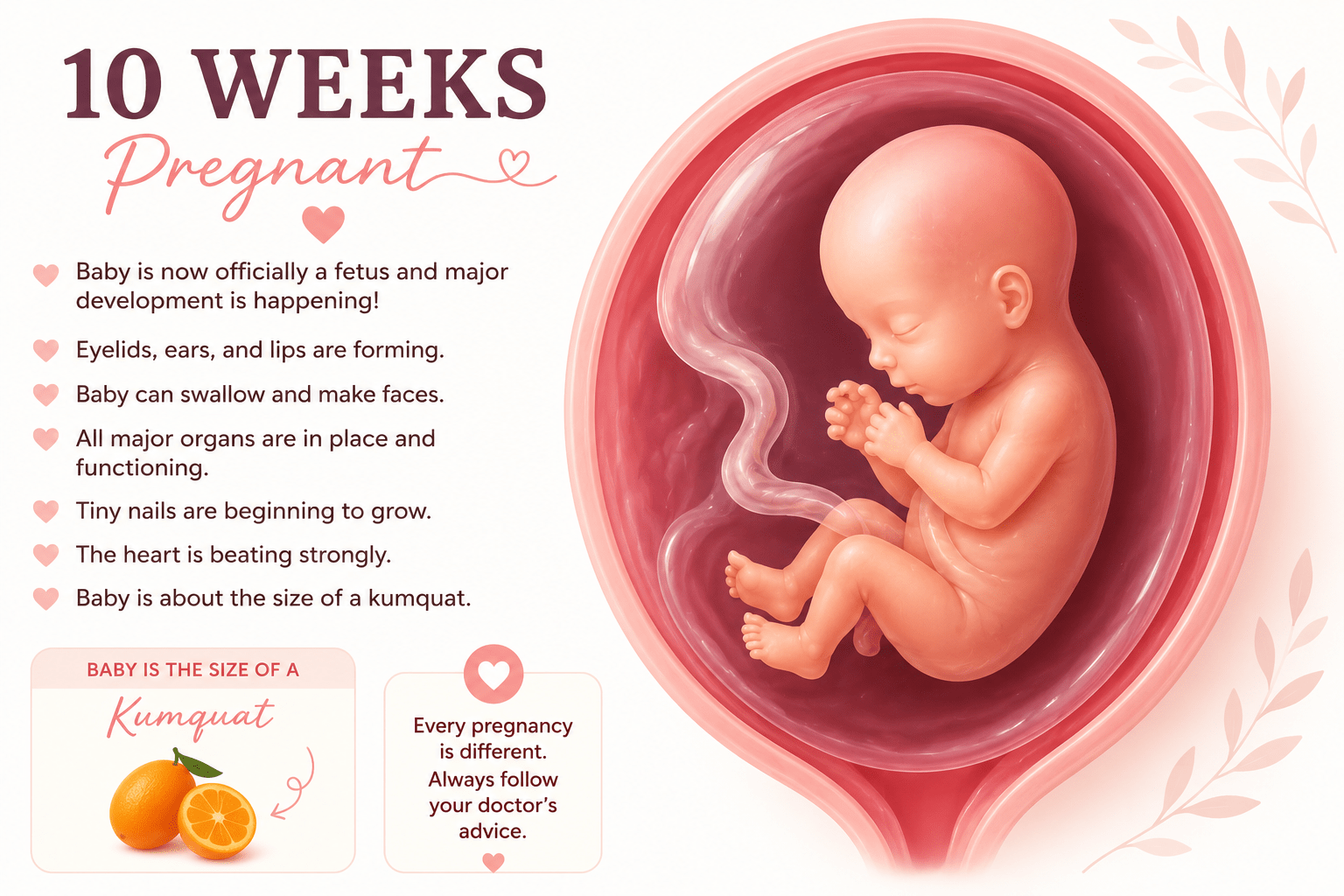
At 10 Weeks Pregnant, your baby is growing fast and beginning to look more baby-like. The head is still large compared with the body, but facial features, limbs, fingers, toes, eyelids, ears, and early organs are continuing to develop.
The NHS says that at 10 weeks pregnant, your baby is around 30 mm long from head to bottom, about the size of a small apricot, and may be making jerky movements that can be seen on a scan. NHS
This week can still feel physically rough. Some women are dealing with nausea, exhaustion, food aversions, smell sensitivity, headaches, mood swings, and breast tenderness. Others may notice symptoms slowly shifting, but it is normal if they are still strong.
How Big Is Baby at 10 Weeks Pregnant?
At 10 Weeks Pregnant, the NHS says your baby is about 30 mm from head to bottom, approximately the size of a small apricot. NHS
Size estimates can vary slightly depending on the source and measurement method. Mayo Clinic describes week 10 as a time when the head becomes rounder, elbows can bend, fingers and toes lose webbing and become longer, and the eyelids and outer ears continue developing. Mayo Clinic
At 10 Weeks Pregnant, baby is still small, but the development is much more recognizable than it was just a few weeks ago. You still will not feel movement yet, even though baby may move on an ultrasound.
Simple explanation: At 10 Weeks Pregnant, baby is about the size of a small apricot according to the NHS. Baby may move on ultrasound, but you will not feel those movements yet.
10 Weeks Pregnant Baby Development
At 10 Weeks Pregnant, your baby’s body is continuing to form and grow. The head is becoming rounder, elbows can bend, fingers and toes are becoming longer, and the eyelids and outer parts of the ears are still developing. Mayo Clinic
ACOG explains that during weeks 9 to 12, cartilage for the limbs, hands, and feet starts to form, eyelids form and remain closed, genitals begin to form, the liver begins development, kidneys begin making urine, the pancreas starts making insulin, and fingernails form. ACOG
Tommy’s notes that at 10 weeks pregnant, baby’s ears are starting to grow on the side of the head, ear canals are developing, the upper lip and tiny nostrils are present, and the jaw contains milk teeth ready to grow later. Tommy’s
The movements at 10 Weeks Pregnant are still too small for you to feel. Even though baby may move in tiny jerky motions, most women do not feel baby movement until much later in pregnancy.
10 Weeks Pregnant Symptoms
10 Weeks Pregnant symptoms can still be strong. Some women feel like nausea and fatigue are near their peak around this time, while others notice small improvements. Both can be normal.
The NHS lists common symptoms around 10 weeks, including extreme tiredness, nausea, mood swings, metallic taste, sore breasts, headaches, dizziness, new food likes and dislikes, heightened sense of smell, milky white discharge, light spotting, and cramping that may feel like period pains. NHS
You may also notice bloating, constipation, frequent urination, food aversions, emotional swings, or feeling hungry and sick at the same time. Morning sickness can happen at any time of day.
- Nausea, vomiting, or food aversions.
- Extreme tiredness or needing more rest.
- Strong smell sensitivity or metallic taste.
- Sore, swollen, or tender breasts.
- Bloating, constipation, or slower digestion.
- Headaches, dizziness, or mood swings.
- Frequent urination or bladder pressure.
- Mild cramping or light spotting for some women.
Is Cramping Normal at 10 Weeks Pregnant?
Mild cramping at 10 Weeks Pregnant can happen. Your uterus is changing, hormones are affecting digestion, and bloating or constipation can add to lower belly discomfort.
Some cramps may feel like light period cramps, pulling, stretching, or pressure. Mild cramping without heavy bleeding can be common, but severe pain should always be checked.
Call your doctor right away if cramping is severe, one-sided, comes with heavy bleeding, shoulder pain, dizziness, fainting, fever, or pain that feels very different from your normal cramps.
Is Spotting Normal at 10 Weeks Pregnant?
Some women have light spotting at 10 Weeks Pregnant. Light spotting does not always mean something is wrong, but bleeding during pregnancy should still be mentioned to your healthcare provider.
If spotting becomes heavy, bright red, painful, or comes with dizziness, shoulder pain, or one-sided pelvic pain, call your doctor quickly. Your provider may recommend monitoring, bloodwork, or an ultrasound depending on your symptoms.
It is better to call and ask than to sit with fear. Early pregnancy bleeding can have different causes, and your healthcare provider can help you decide what to do next.
Can You See Baby on Ultrasound at 10 Weeks Pregnant?
At 10 Weeks Pregnant, an ultrasound may show baby more clearly than earlier weeks. Depending on your exact dating and the type of scan, your provider may be able to measure crown-rump length, check cardiac activity, and see early movement.
The NHS says baby’s jerky movements can be seen on a scan around 10 weeks, but you will not feel those movements yet. NHS
If your ultrasound measurements do not match your expected dates exactly, your provider will explain what that means. Ovulation timing, cycle length, and early measurement differences can affect dating.
Can You Hear a Heartbeat at 10 Weeks Pregnant?
At 10 Weeks Pregnant, cardiac activity is often visible on ultrasound. A handheld Doppler may or may not pick it up yet, depending on baby’s position, your body, the equipment, and provider technique.
If a Doppler does not find it right away at this stage, that does not automatically mean something is wrong. Many providers use ultrasound rather than Doppler in earlier pregnancy because it gives more information.
Your provider will interpret any findings based on your dates, ultrasound measurements, symptoms, and medical history.
What Your Body May Be Doing at 10 Weeks Pregnant
At 10 Weeks Pregnant, pregnancy hormones are still high. hCG and progesterone can affect nausea, digestion, smell sensitivity, breast tenderness, mood, bladder pressure, and energy level.
Your uterus is growing, but you may still not look obviously pregnant. Bloating can make clothing feel tighter, but a true baby bump often develops later.
You may also notice more visible veins, breast changes, or skin changes. Some women feel glowing at this stage, while others feel exhausted, sick, and nothing like themselves.
What to Do at 10 Weeks Pregnant
If you are 10 Weeks Pregnant, you may have your first prenatal appointment soon or may already have one scheduled. This is a good time to write down questions so you do not forget them during the visit.
Keep taking a prenatal vitamin with folic acid if your provider recommends it. Ask before starting, stopping, or changing medications, supplements, or herbal products.
You may also want to ask your provider about genetic screening options, due date dating, nausea relief, safe exercise, food safety, and what symptoms should be reported right away.
- Schedule or confirm your first prenatal appointment.
- Write down questions for your doctor or midwife.
- Keep taking a prenatal vitamin with folic acid if recommended.
- Ask your provider about medication and supplement safety.
- Eat small meals or snacks if nausea is strong.
- Drink fluids throughout the day, even in small sips.
- Call your provider for heavy bleeding, severe pain, or dehydration.
What to Eat at 10 Weeks Pregnant
At 10 Weeks Pregnant, food may still be difficult. Nausea, smell sensitivity, and food aversions can make normal meals hard to manage.
Small, frequent meals may help. Bland foods like crackers, toast, rice, potatoes, applesauce, bananas, noodles, cereal, yogurt, soup, or simple protein options may be easier to tolerate.
If you feel worse when your stomach is empty, try keeping small snacks nearby. If you cannot keep fluids down, feel weak, or notice signs of dehydration, call your doctor.
What Not to Worry About Too Much at 10 Weeks Pregnant
It is normal to worry at 10 Weeks Pregnant, especially if symptoms change from one day to the next. Symptoms can fluctuate, and a slightly better day does not automatically mean something is wrong.
It is also normal not to have a visible bump yet. Many women do not look pregnant at this stage, especially in a first pregnancy. Bloating may come and go, but a true bump usually develops later.
Try not to compare your pregnancy to someone else’s. Every pregnancy has its own symptom pattern, appointment schedule, ultrasound timing, and emotional experience.
When to Call Your Doctor
Most mild symptoms at 10 Weeks Pregnant can be normal, but some symptoms should be checked quickly. Trust your instincts if something feels severe, unusual, or unsafe.
Call your doctor right away for heavy bleeding, severe cramping, one-sided pelvic pain, shoulder pain, dizziness, fainting, fever, or vomiting that keeps you from holding down fluids. This page is for general education and does not replace medical care.
10 Weeks Pregnant Summary
10 Weeks Pregnant is an important first-trimester week. Baby is about the size of a small apricot according to the NHS, and development is moving quickly with fingers, toes, eyelids, ears, limbs, organs, and tiny movements continuing to develop.
The most important things to know about 10 Weeks Pregnant are simple: symptoms may still be strong, mild cramping or spotting can happen, baby may move on ultrasound, and you still may not feel movement for several more weeks.
If you are 10 Weeks Pregnant, keep taking care of your body, stay in contact with your healthcare provider, and call right away for heavy bleeding, severe pain, dehydration, or symptoms that worry you.